By Val Thorpe, Director of Operations
New Jersey residents are experiencing first-hand the devastating effects of climate change. Over the past several months, severe storms have brought dangerous lightning strikes and widespread flash flooding across the state. As these types of storms increase in intensity and frequency, they will continue to significantly impact our homes, our communities, and our lives.
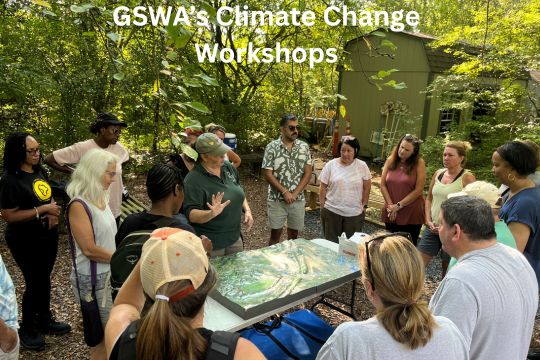
Recognizing that educating the next generation on this critical topic is key to finding solutions, New Jersey took the lead and became the first state requiring climate change education for all K-12 students across every subject area. Now, for the second consecutive year, GSWA is partnering with Ramapo College and other environmental organizations to train local public-school teachers through the statewide Climate Change Learning Collaborative (CCLC), funded by a grant from the NJ Department of Education.* These professional development workshops are offered to teachers to understand the mechanisms of climate change and incorporate high quality climate content into their curriculum.
“Providing firsthand experience to educators and focusing on solutions-based thinking can help our state cultivate the next generation of climate scholars who must address climate change impact. Kids need to understand the real science of what’s going on in order to make informed decisions about the major changes our nation needs to take,” said GSWA’s Hazel England, Director of Education, Outreach, and Stewardship.
In preparation for these workshops, GSWA first developed a comprehensive series of professional development teacher sessions, which kicked off in early July. These 11 field and classroom-based sessions, offering a wide range of hands-on learning, filled up quickly. However, additional sessions will be offered during the upcoming school year.**
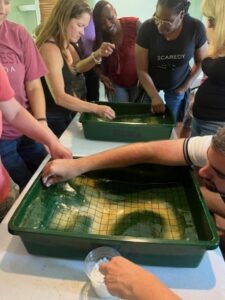
The frequent flooding of some Passaic River communities causes major quality of life and economic impacts. Our homemade models illustrate how these communities are impacted by repeated flooding.
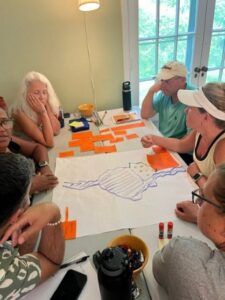
Teachers plan their community, locating housing, commerce, and open space around a wetland. This illustrates how their development fits along the river upstream and potential downstream of impacts.
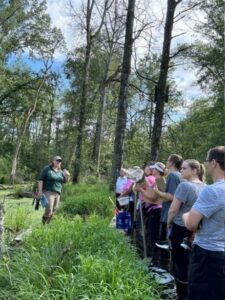
With tree identification, math, and an online app, teachers learned how to calculate the tons of carbon a single tree can store and sequester, providing a deeper understanding of photosynthesis.
Below is a summary of the first half of the GSWA-led workshops:
Day 1: Intro to Climate Change provided a foundational understanding of the difference between climate and weather, and how climate change specifically is already impacting New Jersey.
Day 2: Every Drop Counts took place at GSWA’s Conservation Management Area (CMA) in Harding Township, [Val to add pics] where teachers gained hands-on experience collecting water samples and visual water quality data.
Day 3: Passaic from Source to Sea was a field trip that took participants from the industrial mouth of the river to the pristine headwaters, applying the skills they had learned the previous day. Starting at Riverfront Park in Newark and progressing upstream, the trip made stops at Dundee Dam in Garfield, Paterson Falls in Paterson, Stanley Avenue Park in Summit, and the source of the river in Mendham.
At each site, participants discussed how that part of the river was visually different, noting how a rain event might affect that location. They also measured water quality and surveyed for macro-invertebrates at each site.
“Teachers understood how the Passaic River offers powerful, place-based case study for understanding water quality protection. It clearly shows how increased precipitation, droughts, and hurricanes affect it from source to sea. The water quality and storm impacts near its source in Mendham are vastly different as you travel downstream, illustrating how climate change impacts New Jersey’s urban and suburban communities,” said Hazel England.
Day 4: Learning from “The Lorax” utilized “climate fiction” as a springboard into teaching various climate issues. By letting diverse voices tell their own climate stories, teachers can students to others’ worldviews.
Day 5: Exploration Around the Schoolyard used math, science, and language arts in experiential activities. They focused on how to use playgrounds and green spaces to explore local impacts of climate change, such as how stormwater moves around these sites, or how temperatures drastically differ between blacktop and open space.
The mid-August, workshops on Days 6, 7, and 8 focused on two major topics:
- Microforests (tiny forests): Participants explored how these small-scale forests can be used in urban settings to enhance biodiversity and combat climate change.
- “Improved” Playgrounds: This hands-on activity highlighted the issues with playgrounds built on impervious, non-shaded surfaces, which can lead to dangerously high temperatures.
To date, approximately 170 teachers have participated in GSWA’s workshops. As part of the CCLC grant, participants leave with all the resources and activities from the session(s) they attend, and the materials to turnkey the lessons in their own classrooms.
Additional student field trips will be offered in the upcoming school year as well as in-school professional development for specific schools and students. Climate based-field experiences take place at GSWA’s Conservation Management Area (CMA) in Harding Township. CCLC workshops are also offered through Monmouth University, Rutgers University, and Stockton University.
* The Climate Change Learning Collaborate (CCLC) is funded by the New Jersey Department of Education Year 2 Grant and aligned with mandated New Jersey state standards. This standard was passed in 2020 and is now being boosted by the Department of Education.
**For more information on the Climate Change Learning Collaborative and to register for upcoming sessions, click HERE.